
How streamlining internal complexity turned a struggling GSI relationship into a 1,400% revenue opportunity—and why your biggest partnership problem is actually structural, not tactical.

Table of Contents
- Opening: The Black Box Problem
- The Real Cost of Reactive Partnership
- The Streamlining Decision: From 3+ Months to 1 Week
- Why Misaligned Incentives Kill Deals
- Complexity Is a Competitive Weapon (Against You)
- What Partner Ecosystem Architecture Actually Means
- The 1,400% Growth Didn’t Come From More Partners
- The Biggest Mistake: Overcomplicating the Black Box
- The Unfair Advantage
- What Partner Ecosystem Architecture Actually Is
- The Question for Your Organization
- Next Steps
Opening: The Black Box Problem
I walked into a partnership dysfunction that most software leaders recognize but few admit: our largest GSI partner felt like they were shouting into a black box.
One of the world’s top SAP integrators—a company that runs transformational projects across Fortune 500 companies—was frustrated with us. Not because our product was weak. Not because pricing was wrong. But because engaging with us felt like solving a puzzle every single time!
Here’s what was actually happening:
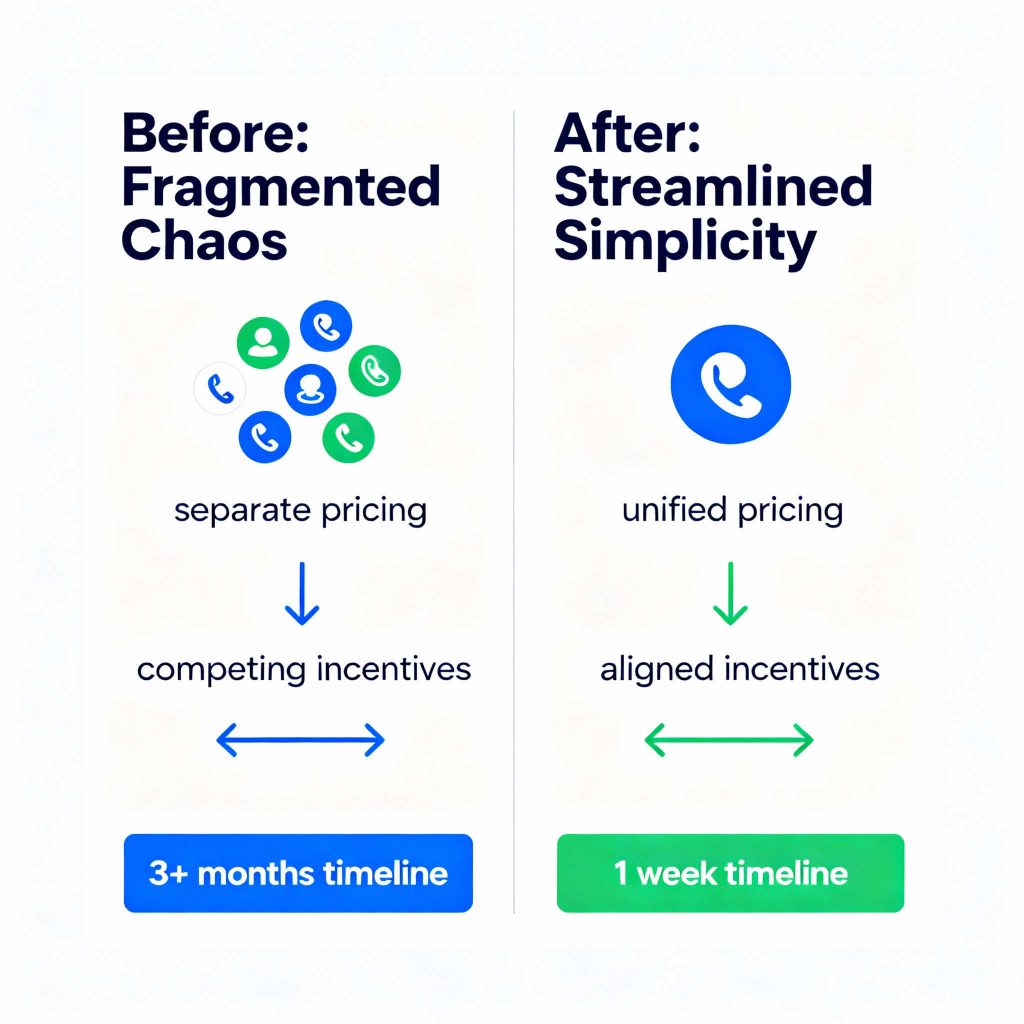
They needed a combination of our content management platform, business process orchestration capabilities, and professional services. Sounds straightforward, right?
In reality, they had to:
- Email five different business unit contacts to understand who owned what
- Request three separate quotations from three different pricing teams
- Navigate competing internal interests (each business unit optimizing for their own revenue, not the deal)
- Wait 3+ months for everything to come together
- Often discover the entire package was unprofitable for them once all costs were calculated
Then they’d quietly move that deal to a competitor who was simpler.
This wasn’t a channel problem. This was an architecture problem.
The Real Cost of Reactive Partnership

When I inherited the GSI business, the approach was straightforward: react to incoming requests. Partners called, we answered. We had no proactive strategy, no joint business planning, no account mapping. Just deal-by-deal firefighting.
The problem with that model is it only works if your organization is simple. But most enterprise software companies aren’t simple. We have multiple business units, different sales teams, competing incentives, and separate pricing models. That complexity is invisible when you’re selling direct. It becomes a partner’s nightmare.
I spent time analyzing where the real friction lived. The data told a story I didn’t expect: 80% of the deals from our top GSI partners followed repeatable patterns. The same firms were including the same 4-5 products in nearly every BOM. Not random. Systematic.
But our organization treated it randomly.
Every deal required re-negotiating as if it was the first deal. Different contacts. Different processes. Different pricing discussions. Every deal felt like a starting from zero, not building on proven success.
That’s when I realized: our partner ecosystem wasn’t broken, rather our internal architecture was!
The Streamlining Decision: From 3+ Months to 1 Week

The fix wasn’t complicated, but it required something harder: internal alignment.
Instead of three separate SKUs with three separate price lists and three separate sales contacts, we bundled them into one offering. Content management + process orchestration + productized services = one bundled solution with one price, one owner, one frame agreement.
1 point of contact. 1 process. 1 answer.
The timeline collapsed: 3+ months of back-and-forth became less than 1 week from deal definition to contract signed.
But here’s what mattered more than speed: the deals became profitable for the partner. Without internal hand-offs and competing margin calculations, they could actually price competitively for their end customer. They could stack multiple deals. They could scale.
In just over a year, revenue from this single initiative grew 1,400%. Not 14%. Not 140%. 1,400%!
That number wasn’t from recruiting more partners. It was from making partnership so simple that the best partners wanted to scale it with us.
Why Misaligned Incentives Kill Deals

This is the part most companies never investigate or simply overlook.
Sales incentives in most organizations are vertical—individual sales rep quota—or siloed by business unit. Each unit optimizes for their own number. The partner, meanwhile, is trying to orchestrate a horizontal combination of those products.
Fundamental misalignment.
When your sales organization is fragmented, your partner experiences that fragmentation. You can’t hide it. They feel it immediately:
- Why do I need to contact three people to get pricing?
- Why does each unit have different payment terms?
- Why is one business unit incentivized to compete with me instead of complementing me?
- Why do disputes take weeks to resolve when nobody has clear decision authority?
The answer isn’t to train partners better or have more conversations. The answer is to fix your own internal architecture first.
We did that by:
- Creating one bundled SKU with clear ownership (not design-by-committee)
- Setting transparent pricing with no internal negotiations happening after the fact
- Aligning incentives so every business unit wins when the bundle wins (not competing for internal commission)
- Establishing clear decision rights so GSI always knew who to contact and who would make the call
The result: the partnership moved from transactional to strategic. What started as one of 1,000 vendors suddenly became a strategic partner. Other business units wanted to replicate the success. Doors opened that had been closed.
And all of this – not because we recruited better. Because we got simpler.
Complexity Is a Competitive Weapon (Against You)

Here’s something most executives don’t understand about Global System Integrators:
Our Partners live in the complexity business. GSIs manage 100+ software solutions in a single transformational implementation. Their entire competitive advantage is navigating through that complexity for their customers.
So when a software vendor adds complexity to the integration process, GSIs don’t have time to work through it. They don’t have capacity to negotiate your internal politics. They don’t care how reasonable your process is if it slows them down.
They move to a competitor whose product is good enough and simple.
This is not theoretical. I watched it happen. The moment a partner realized they could achieve 85% of their objective with a competitor while using 40% less energy, they made the switch. Product quality no longer mattered. The competitor was “good enough” + frictionless.
Complexity isn’t a feature. It’s a cost they calculate instantly.
Every organization believes their process is justified. “We need three approvals because we need risk management.” “We need separate quotations because it tracks accountability.” “We need different contacts because the business units are separate.”
From the partner’s perspective: That’s your problem to solve, not ours to navigate.
The architectural insight is this: simplicity becomes competitive advantage.
When you’re the vendor who:
- Has one sales contact instead of three
- Provides one price list instead of routing requests
- Requires one SLA instead of multiple negotiations
- Offers one escalation path instead of disputes bouncing between business units
…you’re not just easier. You’re the vendor GSIs will choose first when they run transformational projects.
What Partner Ecosystem Architecture Actually Means

Architecture sounds abstract. Let me make it concrete.
Partner ecosystem architecture = the decision framework + governance structure + incentive alignment that enables partners to grow predictably.
It’s not about having the most partners. It’s not about the best training program.
It’s not about who has the biggest partner event.
It’s about: Can a GSI understand your ecosystem in two sentences? Can they explain your pricing to their customer without calling you? Do they know who owns the relationship?
Can they predict how you’ll respond to their requests?
If the answer to any of these is “no,” you have an architecture problem.
Four structural elements matter:
1. Partner Segmentation by Repeatable Motion
Not all partners are equal. Don’t pretend they are.
Your top 20% of partners probably follow 3-4 repeatable selling patterns. Map them. Those are your Tier 1 partners—they get bundled offerings, frame agreements, joint business planning, and a dedicated relationship owner.
Tier 2 (opportunistic, lower volume) gets different structure.
Tier 3 (emerging, test-and-learn) gets different structure.
Each tier gets appropriate governance, different SLAs, different escalation paths.
This is where most companies fail: they try to run all partners through the same process, which works for none of them.
2. Clear Decision Rights and Accountability
Who owns the bundled SKU? One owner. Not a steering committee. Not a consensus. One person accountable for its success.
Who decides pricing? One answer, not re-negotiation between business units.
Who’s responsible for partner success metrics? Clear accountability, not diffused responsibility.
When problems appear (partner vs. another customer, partner vs. direct sales)—who decides? Written rules, not politics that change based on who’s shouting loudest.
The governance doesn’t need to be complicated. It needs to be clear.
3. Incentive Alignment: Internal + External
Your sales team bonus should reward the bundled offering sale, not incentivize them to break it apart for higher individual commission.
Your business unit leaders should have shared responsibility for partner success, not just their unit’s revenue.
Your partner should see one transparent price list and SLA. No surprises. No special pricing that makes them feel like they got a worse deal than someone else.
When incentives are misaligned—even slightly—partners feel it.
4. Simplicity as Design Principle
Every process, form, and decision path should pass one test: Does this add value for the GSI or just internal complexity?
If a partner can’t explain your sales process in 2 sentences, it’s too complicated.
If internal approvals are required before a partner gets an answer, you’ve failed the architecture.
If partners need a relationship manager just to navigate your organization, something is broken.
Simplicity isn’t a feature you add. It’s a principle that eliminates everything unnecessary.
The 1,400% Growth Didn’t Come From More Partners

This is the insight that changes how you think about scaling partnerships.
Most organizations think: Growth = recruit more partners, train them better, load them with more leads.
What actually happened in this case was different. Growth = make it so easy for existing partners to sell more, faster, and recommend you to other partners.
The compounding effect looked like this:
- Year 1: Streamline one repeatable motion. Bundle the SKU. Create frame agreements. Assign one owner. Remove internal friction.
- Immediate result: The top GSI sells the bundled offering 10x faster (because there’s no internal complexity to navigate).
- Secondary result: Other GSIs see your success and want to replicate it (because you’re the vendor who’s actually easy to work with).
- Replication: Those partners adopt the same streamlined model (it’s already built; the architecture is proven).
- Exponential growth: From partner leverage, not partner multiplication.
The revenue grew 1,400% not because we recruited 14x more partners. We strengthened strategic relationships with top partners, made their business more profitable, and let that success spread through their networks.
This is what architecture enables: partner success, not constant churn of new recruitment.
The Biggest Mistake: Overcomplicating the Black Box
The honest truth: the architecture problem was my responsibility to solve, and it took longer than it should have.
Most organizations (including mine, initially) try to solve partnership challenges with training, more communication, or better partner programs. “If we just explain ourselves better…” or “If we had more touchpoints…” or “If partners understood our business model…”
None of that matters if your internal architecture is broken.
The real issue was that we were managing competing internal interests instead of making clean decisions. Business units wanted their own pricing models. Different sales teams wanted separate quotations. Leadership wanted to preserve unit autonomy.
All reasonable. All understandable. All catastrophic for partners.
GSIs don’t have time to navigate your internal politics. They won’t. When you ask them to, they leave quietly. By the time you realize you lost them, they’ve already chosen a competitor.
The harder truth: fixing the architecture means making trade-offs that some internal leaders won’t like.
Choosing which business unit owns the bundled SKU means one unit doesn’t own it. Creating one price list means aligning around one cost structure, not negotiating margins separately. Establishing clear decision rights means some decisions move out of certain teams’ hands.
Not every leader is comfortable with that. But if you’re serious about partner growth, those are the decisions you have to make.
The Unfair Advantage
Here’s what this architecture created: an unfair competitive advantage.
When you’re the vendor who is simple to integrate, simple to price, simple to escalate issues with—you become the default choice for large transformational projects.
GSIs choose vendors who make their life easier, not harder. Particularly in complex environments where they’re already managing 100+ software solutions.
The paradox: The more enterprise software companies try to be everything, the more complex they become. The simpler you are, the more enterprise projects you win.
That’s not a channel strategy. That’s business architecture. And it’s what transforms partnerships from transactional to strategic.
What Partner Ecosystem Architecture Actually Is
Let me refine that definition I mentioned:
Partner ecosystem architecture is the structural foundation that enables partners to grow predictably with you, untouched by your internal complexity.
It’s the difference between:
- Recruiting partners vs. enabling partners to scale
- Managing relationships vs. architecting success
- Having a channel vs. building an ecosystem
- Reacting to partner requests vs. designing for partner success
The architecture isn’t the org chart. It’s not the partner program. It’s the underlying decision framework that makes everything else simple.
The Question for Your Organization
If you walked into your largest GSI partner tomorrow and asked them: “What’s one thing we could change that would make partnership with us 50% easier?”—what would they say?
If you don’t know, that’s an architecture problem.
If they said something about process complexity, internal contacts, or pricing clarity—you have a clear roadmap for this quarter.
If they said they’d never thought about it because the partnership works so well—you’re already on winning path, but I still recommend to dig deeper.
Most organizations aren’t there. Most organizations are somewhere in between: partnerships that work, but with friction. Deals that close, but slowly. Growth that happens, but not at the scale it could be.
That friction isn’t inevitable. It’s architectural. Which means it’s fixable.
The question is whether you’re willing to make the trade-offs required to fix it.